Chitwan
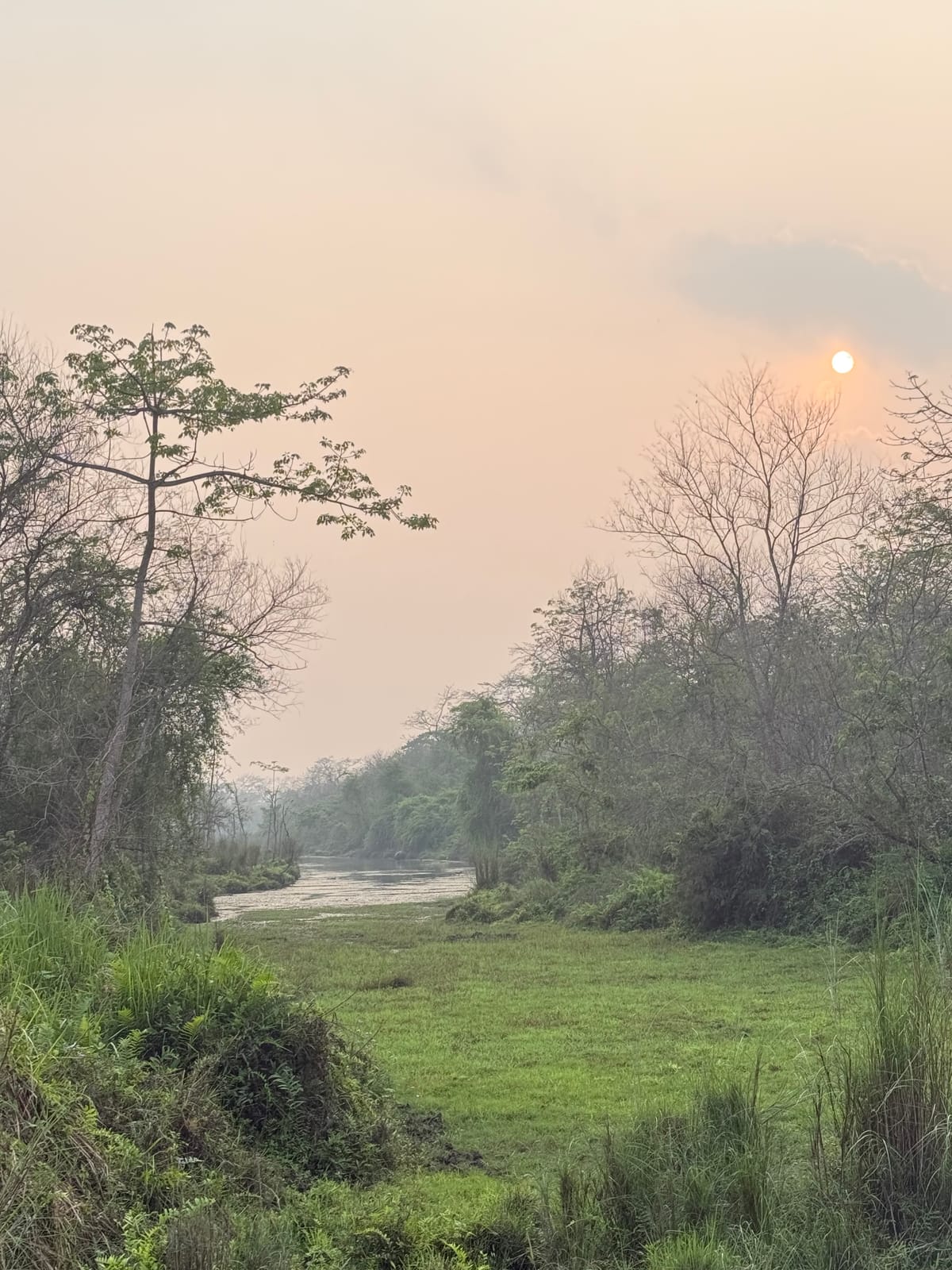
March 29–31, 2026
Part 1 — The Engine Off
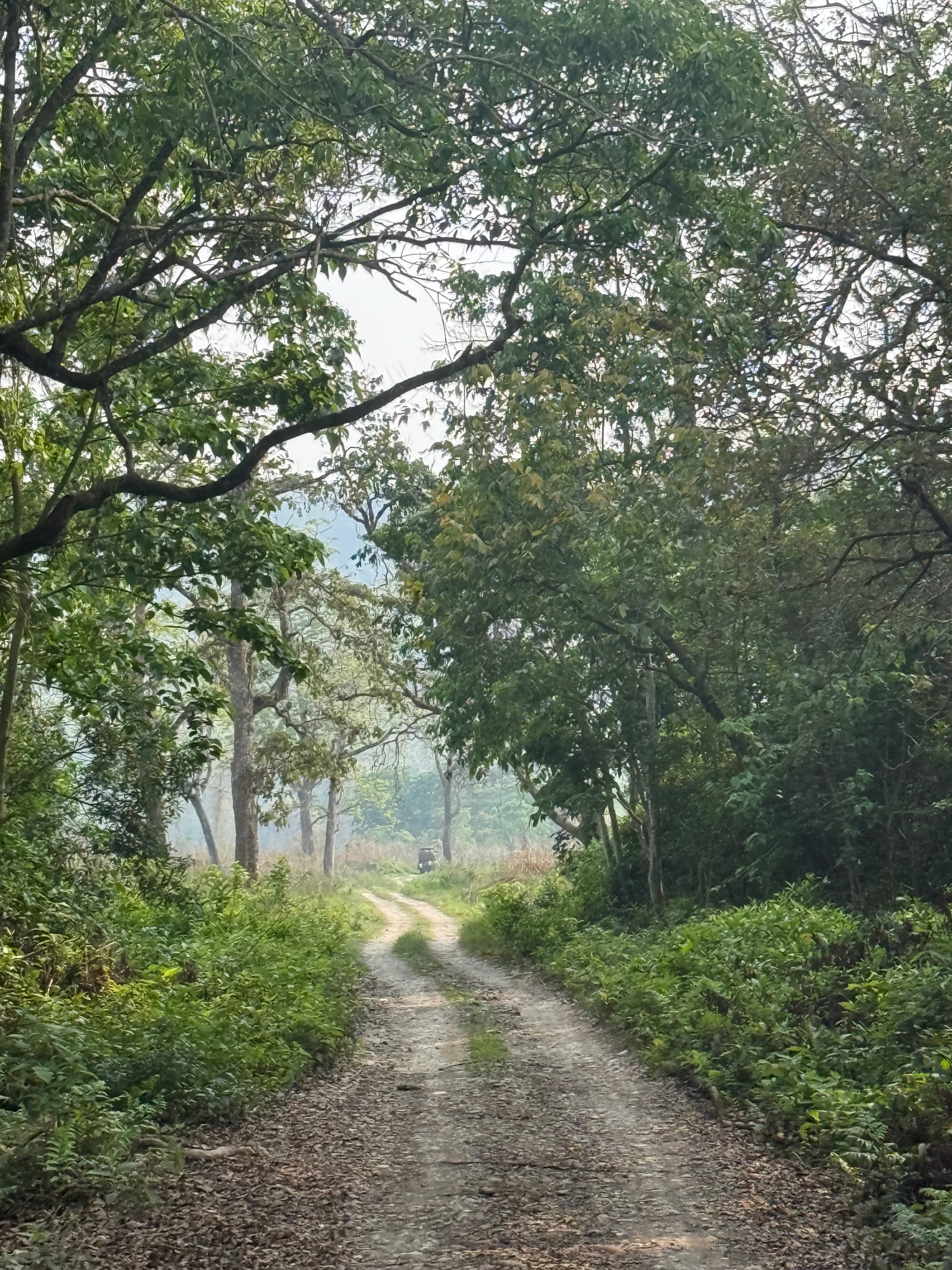
On a jeep safari.
One-horned rhinos emerging out of tall grasses.
Tree trunks twisted by time. Vines tightening their grip, slowly claiming what stands.
Lemurs appearing and disappearing through the branches.
A wide variety of birds threading the air.
All of it compelling.
On that first day, I was paired with a British couple. We moved through the park in a rhythm of motion and pause. At various points, the engine would be cut, and we would simply sit.
It was in those moments that something began to reveal itself.
The silence.
Not empty. Not inert.
Alive.
It had a presence that was both expansive and intimate—enveloping, yet never demanding.
Nothing in it stimulated, yet everything felt more vivid.
It was deeply comforting. And strangely familiar.
It struck me that this is always available—
that what we call silence is not the absence of life, but its quiet expression.
And that to notice it requires something very simple:
To turn off the engine.
Not just the jeep’s engine—
but the inner one.
The constant commentary.
The naming, comparing, evaluating.
When that settles, even briefly, something opens.
All day long we moved in this rhythm—forward, then pause.
Movement, then stillness.
Even the way our guide and driver spoke seemed shaped by this. Their voices were hushed, almost instinctively, as if anything louder would be out of place. Not imposed, but contagious—a shared reverence.
The stillness wasn’t something added to the experience.
It was the experience.
And it made clear how rarely we encounter this—
how easily it is obscured by the noise of the modern world.
Being bathed in it felt like a kind of restoration.
Less that the environment created a feeling—
more that something in me aligned with what was already there.
As if the stillness within and the stillness of the world were not separate.
And in that meeting, something essential revealed itself.
Part 2 — Nearness
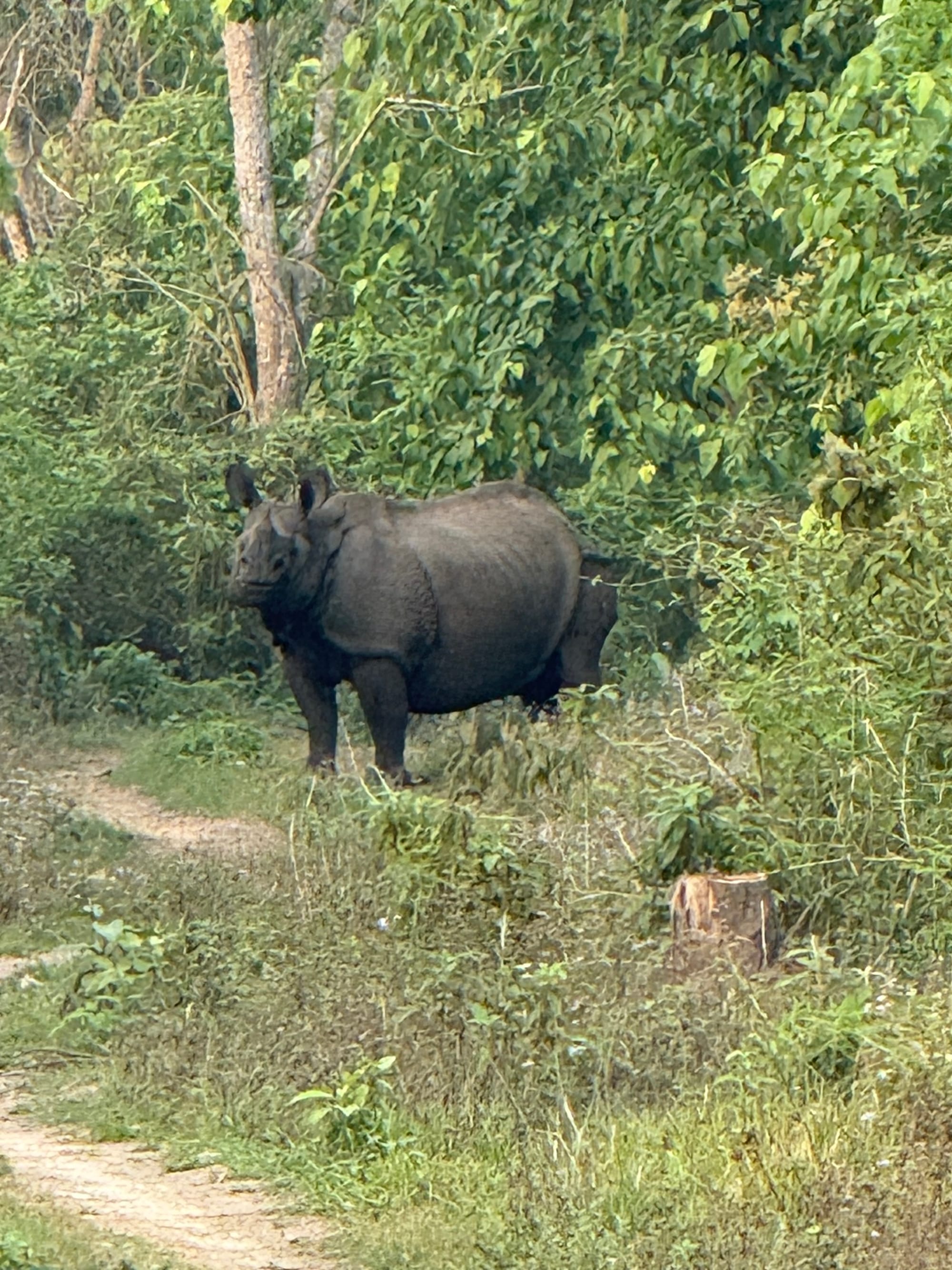
The following day I returned for a private jeep safari, this time with the same guide, Danny.
There was a continuity from the day before—
the same movement between motion and pause,
the same quiet attending.
But something deepened.
At one point, we came upon a small family of rhinos—
a mother, a young calf, and two adolescents.
They moved toward us slowly, without alarm.
For a time—perhaps twenty minutes—we were alone with them.
At one moment, they were no more than ten feet away.
There was no sense of intrusion.
No heightened urgency.
Just a shared space.
Another form of presence meeting this one.
We had seen rhinos the day before, along with other animals—each encounter interesting in its own way. But this was different. Not because it was closer, though it was. Something in the quality of attention had shifted.
It felt less like observing,
and more like participating in the same field.
Part 3 — Danny
Danny seemed to move as if the forest had already instructed him.
Nothing in him reached outward.
Nothing tried to gather attention.
His voice came softly, as though it belonged to the same field we were sitting in.
His gestures were minimal, precise—never disturbing what was already complete.
There was no sense he was guiding me through the jungle.
He was simply… in it.
And somehow, that was enough.
At first glance, I took him to be older than me.
When he told me he was 69, I paused.
Not because of the number—
but because of the quality of his presence.
There was a settled ease.
Not resignation. Not withdrawal.
A quiet aliveness.
It felt familiar.
Or perhaps more accurately—
it pointed me back to something I have been recognizing in myself.
Approaching 78, I notice a growing contentment.
Not derived from what I’ve done,
but from how I am here.
Less compelled to seek.
More willing to allow.
As if aliveness is not something to be achieved,
but something that remains
when nothing unnecessary is added.
Being with him, I found myself wondering—not in a striving way, but quietly—
what it means to live like this.
Not as an ideal.
Not as something to achieve.
But as something already available,
when the unnecessary falls away.
At this stage of my life, approaching 78,
I feel less interested in becoming anything more…
and more interested in being aligned with what is already here.
If there is a vision, it is a simple one:
to live with this kind of ease,
this kind of attentiveness,
this kind of quiet participation in the world.
Part 4 — The River Carries
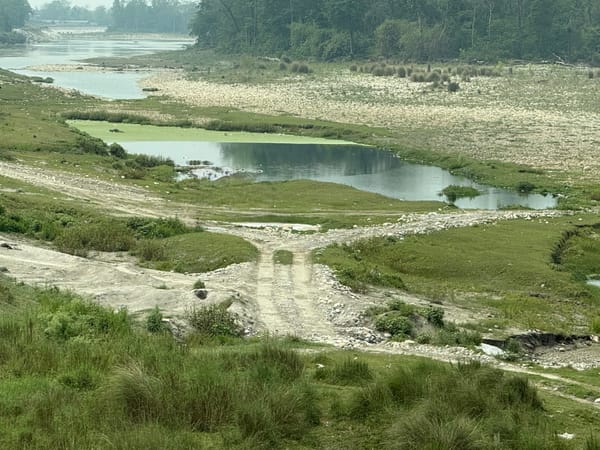
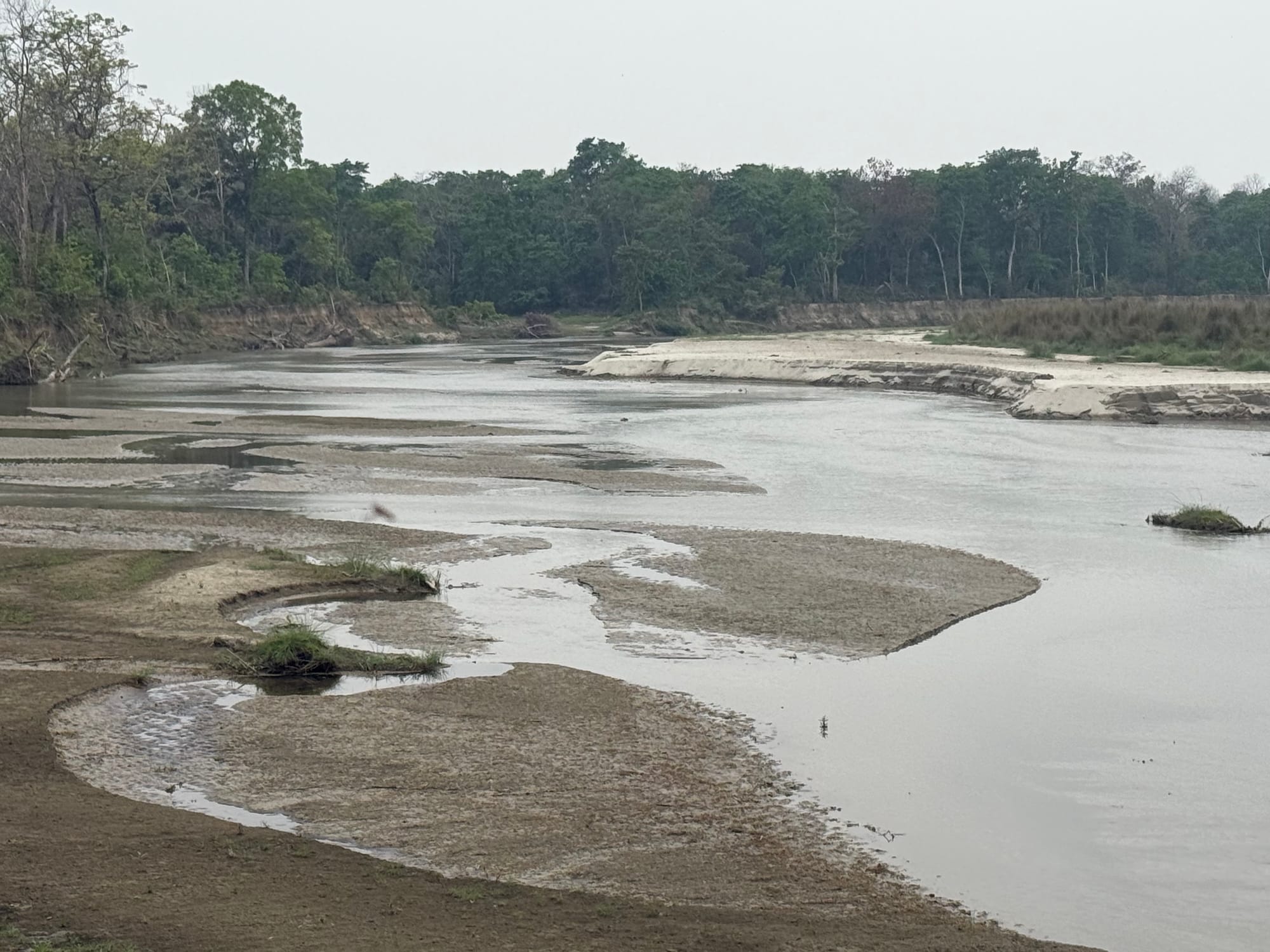
Earlier that day, we took a boat along the river bordering the park.
We drifted.
The current carrying us without effort.
Egrets along the banks. Ducks slipping across the surface.
A rare glimpse of a gharial—ancient, almost improbable.
There was a dreamlike quality to it all—
as if we were moving between layers of reality rather than through space.
And then—
Along the riverbank, a funeral.
Villagers gathered in a circle around a raised body.
They moved together, circling it three times.
There was sound, movement—energy.
But it did not feel solemn in the way I am used to.
It felt participatory.
Almost celebratory.
As if the community itself was generating a kind of force—
a vortex—
carrying the one who had passed onward.
Not just witnessing death, but accompanying it.
Watching this, I found myself thinking of a dear cousin who had passed just days earlier.
A quiet sadness arose—
that he would not hear the stories I was now living.
And yet, something else was present alongside it.
A recognition.
Of how we come and go.
As Joni Mitchell wrote,
“between the forceps and the stone.”
Travel seems to amplify this.
The constant arrivals and departures.
People entering and leaving our lives—some deeply, some in passing.
All of it touching us.
None of it staying.
Everything moving.
Everything returning.
At times it feels as if all of this dissolves into something like a vast emptiness—
a kind of nothingness.
And yet, it doesn’t feel empty.
More like a field in which everything briefly appears, leaves its trace,
and fades.
What remains is not the form—
but the movement.
The living current we all share.
To feel this while alive—
to really feel it—
has a kind of poignancy.
And unless we give it some form—
through memory, through words, through attention—
it slips away.
Back into that same quiet field from which it came.